
Celebrating real-world uses of the International Classification of Functioning, Disability and Health
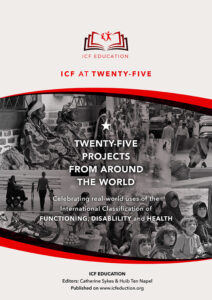
The International Classification of Functioning, Disability and Health (ICF) is a statistical tool developed by the World Health Organization (WHO) and its network of collaborating centres for the Family of International Classifications (WHO-FIC Network). It was endorsed by the World Health Assembly on 22nd May 2001. The iterative and collaborative development involved academics, health and welfare administrators, statisticians, health professionals and, importantly, people with disabilities and their representative organisations.
As a new classification people needed to learn about how it could be used for a range of purposes. In the early years publications focused on introducing the classification to their readership and ICF e-learning was produced by the Education and Implementation Committee (EIC) of the WHO-FIC Network.
As more that people got to know about the ICF so increased the demand for education about how to translate theory into practice using the classification to build ICF based data collections. The online portal ICFEducation.org was developed to share resources and provide access to ICF advisors and educators as one way to meet the need. A course for ICF facilitators was developed and promoted on the portal. Building on a course developed in the Netherlands in 2015 and the translated courses run by the ICF Education coaches in Africa, India and South Korea, the ICF facilitators course was delivered as a blend of face-to-face workshops followed by 6 months of interactive online education. Since 2020 the course has been delivered entirely online. A total of 129 participants from 24 countries from all regions of the world have completed the course.
The end point of the course is the delivery of a ‘Final Project’ by the participants operationalising ICF in their own context. Participants have summarised their final projects into one-page documents for inclusion in this celebratory publication.
We would like to celebrate twenty-five years of ICF by showcasing what these dedicated people have done to improve people’s functioning by using the ICF in their own countries and situations. We hope that you enjoy reading about these innovative applications of ICF.
Thank you to all the participants for their continued commitment to ICF use and sharing their stories about how they have done so.
ICF Facilitator Course Coaches:
Huib ten Napel (WHO-FIC Collaborating Centre in the Netherlands),
Stefanus Snyman (WHO-FIC Collaborating Centre in South Africa),
Catherine Sykes (University of Sydney, Australia)
Michelle Janse van Rensburg (University of the Witswatersrand, South Africa)
Haejung Lee (WHO-FIC Collaborating Centre in the Republic of South Korea),
Thomas Maribo (Aarhus Universitet, Denmark) (joined the team in 2026).
Guest lecturers:
Jerome Bickenbach (Swiss Paraplegic Research)
Olaf Kraus de Camargo (CanChild Centre for Childhood Disability Research, Canada)
Matilde Leonardi (WHO-FIC Collaborating Centre in Italy)
Peter Rosenbaum (CanChild Centre for Childhood Disability Research, Canada)
Hillegonda Stallinga (University of Groningen, The Netherlands)